
KK PARTIZAN — The Basketball School That Became a European Brand
Some clubs are remembered for their trophies.
Some for their great players.
And then there are the rare ones where, for decades, one generation gives rise to the next.
That is why the story of KK Partizan cannot be told simply through a list of championships and trophies. A far more interesting question is: how did one club from Belgrade manage, generation after generation, to develop players and coaches who left their mark on Yugoslav, Serbian and European basketball?
From Kićanović and Dalipagić, through Divac, Paspalj, Đorđević and Danilović, to Rebrača, Vujošević’s generations and Bogdan Bogdanović, the names have changed.
The idea has endured.
This is the story of the Partizan basketball school.
Before the Great Players, There Was the Professor
To understand why knowledge at Partizan was often more important than money, we have to go back to the man whom the entire Yugoslav basketball world simply called — the Professor.
Aleksandar Nikolić was much more than the coach of a single club. He was one of the people who laid the foundations of the Yugoslav school of basketball, a mentor to generations of players and coaches, and a man whose influence extended far beyond Partizan.
He played for Partizan, later coached the club, led the Yugoslav national team and worked with major European clubs. But perhaps his greatest legacy lived on in the people to whom he passed his knowledge.
Decades later, as Partizan prepared for the greatest achievement in its history, the Professor would appear in this story once again.
Alongside a rookie coach named Željko Obradović.
Kića and Praja — When Partizan Began Conquering Europe
The 1970s brought Partizan two players whose names became part of European basketball history.
Dragan Kićanović — Kića.
Dražen Dalipagić — Praja.
For someone who did not grow up watching Yugoslav basketball, it is difficult to explain just how important this duo was. They were not merely Partizan stars. They were national team players representing a country that belonged among the very best basketball nations in the world.
Dalipagić won Olympic gold, a World Championship and three European Championships with Yugoslavia.
With Kića and Praja, Partizan began building its European pedigree.
The black-and-whites won the FIBA Korać Cup in 1978 and successfully defended the trophy in 1979.
Partizan was no longer simply a club with talented players.
It was becoming a European name.

A New Generation Arrives
The 1980s brought another changing of the guard.
Vlade Divac. Žarko Paspalj. Goran Grbović. Ivo Nakić. Aleksandar Đorđević. Predrag Danilović.
And among the players of that era was a man whose greatest game for Partizan was still to come — except that when it happened, he would no longer be wearing the jersey.
Željko Obradović.
Partizan became Yugoslav champion in 1987. The following season, the club reached the European Final Four and finished third, while in 1989 it won both the Yugoslav Cup and its third FIBA Korać Cup.
That is why one thing needs to be understood.
Istanbul 1992 did not come out of nowhere.
Behind it stood decades of work, European games, great players and knowledge passed from one generation to another.
And then came the season when all of it was about to come together.
1992 — The Season That Became a Legend
Partizan did not enter the 1991/92 season as the favourite to conquer Europe.
Far from it.
The team was exceptionally young.
And the coach?
Until recently the team captain, Željko Obradović practically stepped out of his basketball shoes and straight onto the bench.
Alongside him stood Professor Aleksandar Nikolić.
Dragan Kićanović was part of the club’s leadership, while Milenko Savović also played an important role.
On the court were Aleksandar Đorđević, Predrag Danilović, Ivo Nakić, Nikola Lončar, Željko Rebrača, Zoran Stevanović, Slaviša Koprivica, Mlađan Šilobad, Vlada Dragutinović, Dragiša Šarić and their teammates.
Then came an obstacle no team expects at the beginning of a season.
Because of international sanctions and the decision requiring Yugoslav clubs to play their European home games outside the country, Partizan was forced to spend almost the entire European season far away from Belgrade.
It found a home hundreds of kilometres away.
In Spain.
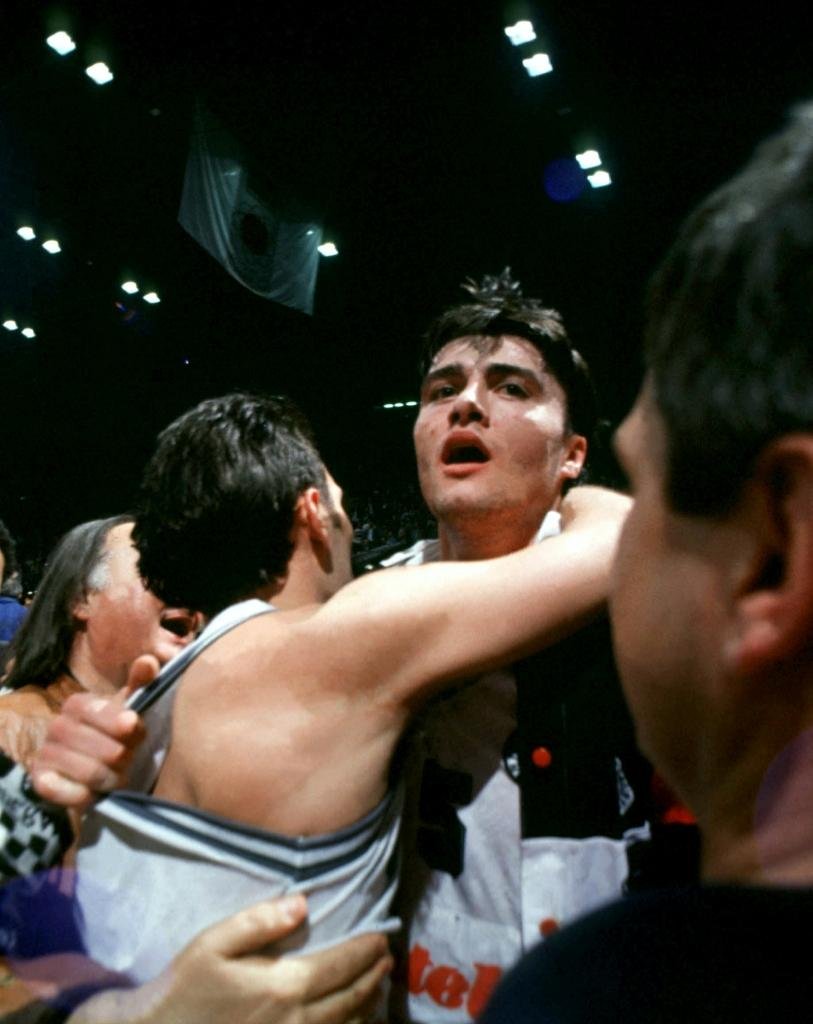
Fuenlabrada — A Home Away From Home
The Madrid suburb of Fuenlabrada became one of the most unusual chapters in European basketball history.
Partizan was only supposed to play its games there.
Something else happened.
The local fans embraced the young team from Belgrade as their own.
They supported Partizan even when it played against Spanish clubs. The bond became so strong that, decades later, it remains part of the identity and shared history of the two basketball communities.
In a season when Partizan had effectively lost its home court, it found another home.
Then came Bologna.
Against Knorr, today known as Virtus Bologna, Partizan secured a place at the Final Four.
The destination:
Istanbul.
Four Seconds for History
Partizan defeated Philips Milan 82–75 in the semifinal.
Joventut Badalona awaited in the final.
16 April 1992.
Abdi İpekçi Arena.
Predrag Danilović scored 25 points.
Aleksandar Đorđević scored 23.
But the final few seconds transformed the game into a legend.
Joventut took a 70–68 lead.
Partizan had one final opportunity.
Slaviša Koprivica passed the ball to Aleksandar Đorđević.
Đorđević raced up the court.
And then — the shot.
Three-pointer.
71–70.
Partizan were champions of Europe.
It was the greatest achievement in the club’s history, and the moment that forever turned one generation into part of European basketball history.
But perhaps even more important is what happened next.
Partizan never stopped developing players.
After Istanbul — A New Generation
A very young Željko Rebrača was already part of the European championship team.
In the years that followed came Miroslav Berić, Haris Brkić, Dejan Tomašević, Predrag Drobnjak and another generation of players.
Partizan returned to the EuroLeague Final Four in 1998.
The European champions moved on.
A new generation arrived.
The school kept working.
Duško Vujošević — Another Great Era
If one Partizan era showed how far a young team could go, the years under Duško Vujošević turned that philosophy almost into the club’s identity.
Partizan often could not compete financially with Europe’s richest teams.
So it had to produce what it could not simply buy.
Players.
Nikola Peković.
Novica Veličković.
Uroš Tripković.
Milenko Tepić.
Jan Vesely.
Vladimir Lučić.
Dragan Milosavljević.
Young players did not wait until they became stars to be given responsibility.
Responsibility was how they became stars.
And in 2010, Vujošević’s Partizan once again achieved something that seemed exceptionally difficult.
It returned to the top four in Europe.
Paris 2010 — Among Europe’s Best Again
The road to Paris went through Maccabi.
Partizan won the quarterfinal series 3–1.
Bo McCalebb, Dušan Kecman, Aleks Marić, Jan Vesely, Petar Božić, Aleksandar Rašić, Slavko Vraneš and their teammates reached the Final Four.
Partizan once again stood alongside Europe’s biggest clubs.
It did not conquer Europe as it had in 1992.
But it showed something perhaps just as important to this story:
the model still worked.
Bogdan — Another Proof of Continuity
When Bogdan Bogdanović emerged at the beginning of the next decade, Partizan once again had a young player who needed space, time and responsibility.
Vujošević gave him all three.
In the 2013/14 season, Bogdanović grew into one of Partizan’s leaders and won the EuroLeague Rising Star award.
He later moved to Fenerbahçe, became a European champion, reached the NBA and established himself as one of Serbia’s most important national-team players.
But his major European breakthrough began in the black-and-white jersey.
That is why Bogdan is not the end of the Partizan school.
He is proof of its continuity.
Partizan Did Not Develop Only Players
There is another line running through the club’s history.
Coaches.
Aleksandar Nikolić.
Željko Obradović.
Duško Vujošević.
Their careers and relationships cannot be reduced to a simple teacher–student line, but they are connected by the idea that basketball knowledge is passed on.
Professor Nikolić was alongside the young Obradović in 1992. Obradović himself later spoke about the support he received that season from Nikolić, Kićanović, Savović and others at the club.
Obradović would go on to build one of the greatest coaching careers in European basketball.
Vujošević would develop new generations through Partizan.
And many years later, the circle would close again.
Željko Obradović returned to Partizan.
Partizan and the Great Serbian Basketball Tradition
It is impossible to completely separate Partizan’s history from the history of national-team basketball in this region.
Kićanović and Dalipagić.
Divac and Paspalj.
Đorđević and Danilović.
Rebrača.
Berić.
Veličković.
Bogdanović.
And many others.
They wore different national-team jerseys through different eras, but Partizan played an important role in their basketball education or development.
That is why this club’s story is not merely the story of one team from Belgrade.
It is one chapter in a much bigger story —
about a country where basketball became part of the culture.
Partizan Today — When Belgrade Becomes a Basketball Stage
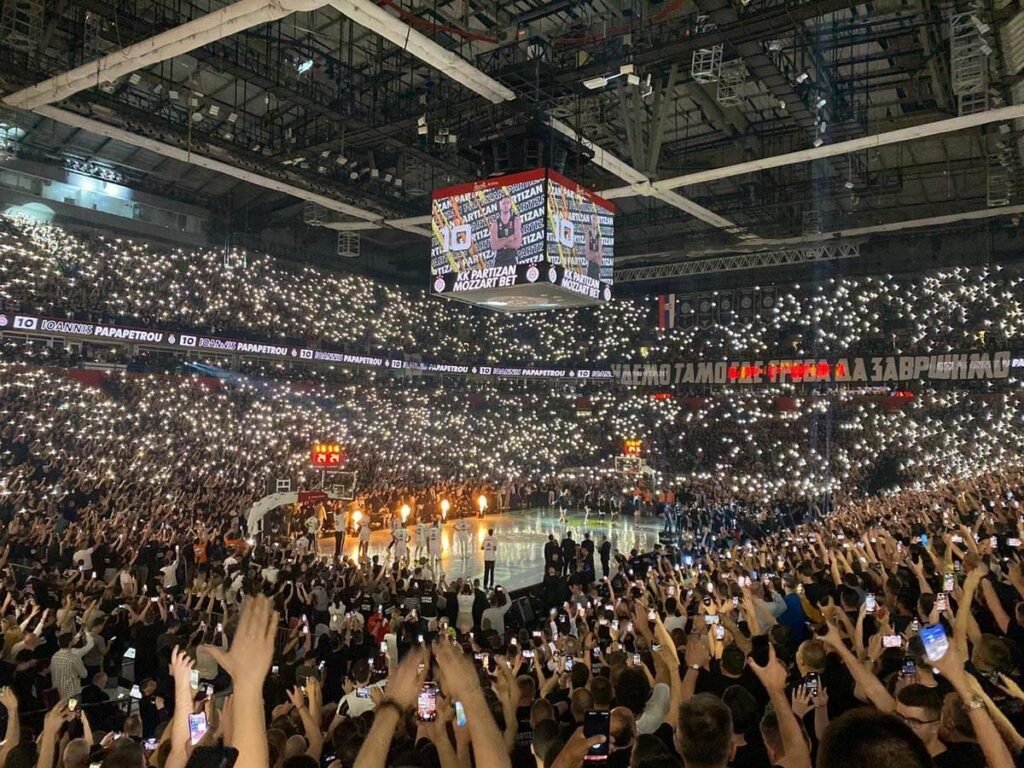
Today, Partizan’s great European nights are played at the Belgrade Arena.
But attendance figures alone cannot explain the experience.
You have to hear the arena in the minutes before tip-off.
See the stands.
Feel the moment when the entire arena reacts to a steal, a three-pointer or a defensive stop.
For a visitor experiencing Belgrade for the first time, a Partizan game can therefore be much more than a sporting event.
It can be an encounter with one part of the city’s identity.
From the Professor to the Arena
And that brings us back to the beginning.
Partizan did not become a European basketball brand because of one three-pointer in Istanbul.
Nor because of one coach.
Nor because of one generation.
Professor Aleksandar Nikolić.
Kića and Praja.
Divac and Paspalj.
Đorđević and Danilović.
Obradović.
Rebrača, Berić and Brkić.
Vujošević and his generations.
Bogdan Bogdanović.
And those still to come.
The trophies remained in the cabinets.
Players moved on.
Coaches changed.
But for decades, one generation has continued to leave something behind for the next.
Perhaps that is Partizan’s greatest trophy of all.
People change. The idea remains.
Experience Belgrade and Serbia
For a traveller who wants to understand Serbia, the landmarks are only the beginning.
You should taste its food.
Hear its music.
Meet its people.
Go beyond the centre of Belgrade.
And if your trip happens to coincide with a great basketball night, you should also experience the city when Partizan plays.
Because some things about Serbia can be explained.
Others have to be experienced.